My Rude Awakening
I was 52 when the truth smacked me in the face. First the visual, and then the data. Here’s what made me decide to get ripped after 40.
My wife and I had taken a vacation to Florida where my folks were living at the time. As people do, we took lots of photos while we were there. When we got back, we were going through the memories together when one of the images I saw of myself punched me in the great big fat man-boob I saw in the photo. It pains me to do it, but here’s the pic.
It hurt me to see how much I’d let myself go, and I knew it was time for a change. However, the confirmation came the next morning when I stepped on the scale after years of not checking my weight. This was punch number two, right in the other man-boob. It said 210 pounds. At no time in my life prior (when I had measured) had I ever gone over 200 pounds. For reference, I’m 5’11” tall. And by the way, don’t use my body as a measuring stick, because we’re all different and your story is likely different than mine.

So here I am, picture and scale showing me very clearly that I’d let myself go. A lot. And what made it sting worse, was that I knew there was nothing to blame except myself, for neglecting my health for so long.
My Self-Assessment and Plan to Get Ripped After 40
First things first, when you come to the realization that you’re not where you want to be, the first step you have to deal with is getting an accurate baseline. You have to confront the reality of what is, whether you like it or not. And those painful pictures and scale weight were powerful visualizations of my current condition.
As much as I may have wanted to deny it, I knew that this was not an age problem. I saw plenty of pictures and videos of people my age or older who were still lean, strong, and looking good. And I’m not just talking about movie stars either. I’m talking about average Joe’s, just like myself, working jobs, raising families, busy with life.
So after acknowledging my baseline, I took to YouTube to get ideas and tips on what to do about it. Holy smokes! There were thousands of videos of people over 40 telling their weight loss stories, offering advice on diet and workout routines, and walking me through all the science and methodology I could handle about crafting a plan to make this change.
It was clear to me that this was a muscle and metabolism problem. Especially because of my age. About 10 years before, and as part of My Mulligan story, I had lost a decent amount of weight (nowhere near as much as I needed to this time) using Beachbody HIIT videos. Specifically, Focus T25 and 21 Day Fix. But even though I lost that weight then, my result was getting skinny. Which don’t get me wrong, feels and looks better than being fat. But I didn’t look lean, I looked skinny. I didn’t look strong, I looked undernourished.
Technically, it was effective. But this time, I wanted something different. And because I had aged a decade since then, my body’s needs for this transformation were different. Muscle burns fat, and I had never to this point trained to gain muscle. Only to lose fat through cardio calorie burns.
The First Big Shift to Get Ripped After 40 – Resistance Training
This time, instead of focusing on burning more calories and lowering the amount I was consuming, I decided, based on my research, to focus on building muscle with resistance training as the foundation. I learned that for people over 40 this is the correct path. Our metabolisms start to slow down after 40, and the more muscle you have, the higher your metabolic rate. Think fat burning engine.
I also learned that after 40, recovery becomes more important than the actual exercise itself. Trust me on this one, because I missed it early on. As we all often do, I saw my photos and scale number, freaked out, and over-compensated in a desperate attempt to fix the problem as fast as possible. I tried doing workouts that may be fine for 20 or 30 year olds. Heavy weights, lots of reps, multiple sets, several times a week. All while reducing my calories by too sharp of a deficit.
Oops! That’s a recipe for disaster. Tendons start to break down. Joints start to ache. Sleep goes to hell. Moods get unstable. Yeah, I lost some weight. And I didn’t feel very good.
Finding the Sweet Spot
Eventually I figured out what works for me. And again I’ll say, just because it works for me, it may not be right for you. So do your own research, and take the time to figure out what fits your body.
I’m now more than 2 years down the road, and have been slowly building more muscle, fine-tuning my program, and eating more food than before. But what’s worked the best for me as a now 55 year old, is a 3 Day Split.
Monday, Wednesday, and Friday I lift weights. I do Push, Legs, Pull, in that order. It allows me to focus on specific muscle groups once per week, and then allow them a full week to recover while I work on other body parts. I also eat at maintenance calories now. Which I didn’t for quite a while during the fat loss stage. I focus on getting plenty of protein, while keeping sugar and saturated fats low for life-long health. I do not restrict carbs, once I’ve met my protein needs, and I don’t restrict fats either, other than the saturated (bad) kind.
This took some time, so be patient with yourself. And don’t over-compensate or try to rush things. You’ll screw up your hormone balance, which will ultimately work against your progress. You’ll also cause more injury than good, not see the results you want, lose strength, and a plethora of other unfavorable reactions. Your body is an incredible machine, and it wants to be healthy, fit, and balanced. But it cannot, and will not, happen overnight.
The Diet and Nutrition Math to Get Ripped After 40
I’m going to give you a few suggestions on how you can use tech to help you calculate how many calories you should be eating, and of which macros. In case you don’t know what a “macro” is, it’s the core nutritional groups you’ve heard a million times: protein, carbohydrates (carbs), and fat.
The first is a BMR Calculator. Here is the definition from their site: “The Basal Metabolic Rate (BMR) Calculator estimates your basal metabolic rate—the amount of energy expended while at rest in a neutrally temperate environment, and in a post-absorptive state (meaning that the digestive system is inactive, which requires about 12 hours of fasting).”
You enter in your height, weight, age, and gender. It will tell you what your daily caloric needs are based on your activity level (sedentary, exercise X number of days per week, intensity level, etc). Once you have this number, it will be easy to determine how much you should be eating to maintain your weight, or lose weight. I like the way this one estimates based on activity level the best.
However, there is also this TDEE Calculator, which is extremely useful. And it also tells you what macros you should eat, depending on whether you’re trying to add weight (bulk), lose weight (cut), or maintain.
Once you have this information, go grab yourself an app for tracking everything. I use Cronometer, but in the past I’ve used Lose It! and MyFitnessPal as well. Pick your favorite, and remember that tracking on any of them is better than not tracking, so don’t overthink it. But know this: if you cheat, it won’t work. Skipping items, or underestimating how much oil or butter you use, or logging that 4 tablespoon helping of peanut butter as 1 tablespoon is just going to hold you back. Nobody wants that.
Summarizing the Math
Depending on your height, weight, and gender, I’m going to leave the deciding what to do with your calories for you to decide. For me, at 210 pounds, when I knew I needed to lose weight, I used a 500 daily calorie deficit below my maintenance.
It’s typically not recommended to go more aggressive than that, unless you have an exceptional amount of weight to lose. Keep in mind that you’ll likely be converting some fat to muscle, and also being more active than before which burns additional calories from your maintenance. So you could be creating a combined deficit of up to a thousand calories a day. 3500 calories is essentially one pound of weight, so 1000 x 7 days in a week = 7000 calories or 2 pounds lost.
If you end up at a 500 calorie deficit, and if you have less weight to lose, then this is about 1 pound a week. Which happens to be a fairly sustainable amount to continue for quite a while.
Diet Breaks and Adjustments
Here’s the thing. Your body will do all kinds of crazy things to keep your systems as close to optimal as possible. And your weight will fluctuate up and down and back again, as you retain water for muscle repair, or find yourself hydrated when you may have been dehydrated before. Your metabolism will rise and fall too.
A bad night of sleep from stress has an effect. The stress hormones you produce in reaction to working your body when it was used to being sedentary can cause stalls as well. The extra blood cells needed to carry more oxygen for the aerobic exercise cause changes. The added muscle tissue, which weighs more than fat, will change your weight as well. That’s why it’s important to give things time to balance out.
It’s also important to know that your weight on the scale is just one measurement. You should also take measurements of your waist, and other muscles to see how they’re changing. I can tell you that at my thinnest and lightest weight I was 165 pounds. That was at the end of the cardio weight loss I mentioned before. But currently I’m 180 pounds, and trust me when I tell you, I look considerably better at this weight than I did at the lower weight. More muscles, more definition, more shape. And I’m 10 or more years older now.
As your body weight declines, your calorie needs may decline as well. So adjustments may be necessary over time. Just do them gradually.
I also recommend diet breaks. Eventually, if you stay in a deficit long enough, your metabolism adjusts. You may begin to feel lower energy, or sleep may suffer. Take a break. It’s OK. If you force through these moments, you’ll lose. Why do I know that? Because I tried. I thought I could “push through”. I couldn’t. You won’t be able to either. So take a diet break. Go back to eating at your maintenance calorie level. You may need to recalculate this now, if you’ve lost weight from when you started.
There are mixed results from studies about diet breaks as far as how they influence your progress. But here’s some real world evidence from yours truly. They help. Even if all they’re doing is allowing you to have a rest. Eat some extra calories, which I assure you that you’ll notice after being in a deficit. You’ll feel stronger, you’ll sleep better, and you’ll 100% notice that extra 500 calories you were missing. For me it’s like having an extra chicken burrito bowl at Qdoba that day, for example.
After you take a 2 week break, get back to it again. You’ll see how much more mentally capable you are after a little respite.
My Actual Weekly Routine to Get Ripped After 40 and Stay There
Monday, Wednesday, and Friday I do resistance training. Monday is Push day, which is chest, shoulders, and triceps. Wednesday I do Legs and Abs. Friday is Pull day, which is back and biceps.
I do two sets of repetitions per exercise. So for example, if incline chest press is my first exercise, I do 2 sets with about 2 minutes of rest between sets. Repetitions vary, but in my mind I’m always targeting around 10. But the “real” goal is to do about 1-2 reps shy of failure. I want to keep just a little bit in the tank. I’m not saying this always happens. It’s just a target.
Sometimes I end up with a grinder because I feel particularly weak that day. A grinder is a failed rep – where form starts to fall apart, or I just can’t finish the motion. It’s not a great idea to have these very often after age 40, because they’re very hard on tendons and supporting muscles. But they happen unintentionally sometimes, and then I move on.
Tuesday and Thursday in between lift days, I do steady state zone 2 cardio. I enjoy elliptical machines at the gym, but this can be a brisk walk, a gentle bike ride, or whatever gets your heart rate into that zone where you can still talk if you want and breathe through your nose. That’s it. You aren’t trying to max calorie burn or break any records.
On Saturday I do one 20 minute HIIT (High Intensity Interval Training) session. For me, it’s on a spin bike with an interval timer app on my phone. 30 seconds of hard work, followed by 90 seconds of rest. 9 of these sets with a 2 minute warm-up and 2 minute cool-down is right around 20 minutes. These 30 seconds of work are breathless.
Unlike the steady state, I get my heart thumping, and I’m breathless. Then I recover during the 90 seconds. This type of exercise, once per week, and after all my lift days, is great for stimulating my production of growth hormone. And it isn’t destructive to my recovery while my body is trying to rebuild the muscle fibers I tore during the week.
Then on Sunday, it’s a light easy day of a gentle walk or slow bike ride, just to keep blood moving and oxygen circulating. But really, it’s resting up for the next week.
Aside from that, I do my level best to get in about 7500 steps a day. Sometimes it’s more, and sometimes it’s less, but over the week, I try to target this much. It makes sure my NEAT doesn’t drop too much from the more strenuous exercises. NEAT stands for non-exercise activity thermogenesis. NEAT is basically moving your arms, tapping your toes, standing and sitting, and everything else you do unconsciously throughout the day which still burns calories. When you work hard in the gym your body sometimes tries to compensate by unconsciously reducing these movements. The baseline for step count makes sure it doesn’t happen, more or less.
My Results and Current Composition
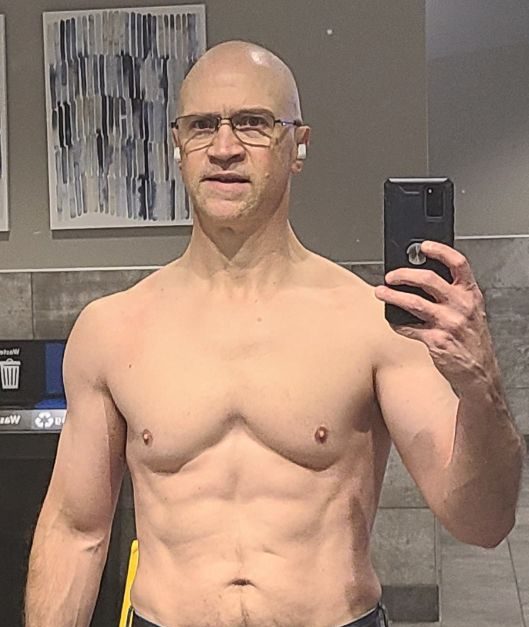
You saw earlier that I went from an all time high of 210 pounds, with an estimated body fat around 23 or 24%, down to my current weight of 180 pounds, with an estimated body fat around 12-13%. You can see my abs and muscle definition, but I’m not “shredded” like a body builder before a show, or a 25 year old who eats a large pizza and 6 beers and just naturally stays lean.
I got down to 10% body fat during this journey, but I realized that sustaining that level (for me) required more sacrifices than I was willing to maintain indefinitely. My energy dipped, my appetite raged, I could never eat a treat, never have dinner out, and frankly the only people who see me shirtless are me and my wife. So it just wasn’t worth it. You may have a different experience.
Oh, this reminds me, I should probably throw this data point in here too, since we live in a world of “enhanced” people who claim they aren’t. I’m natural. 100%. I’m not on TRT, I’m not on peptides, and I’m not taking any steroids. You wouldn’t think I was anyway, because I don’t look like Chris Hemsworth in Thor. But I thought maybe I should say that in case anyone wonders if I’m using any assistance. I’m not.
My philosophy is that I just want to be the best “whatever age I’m at” (currently 55) and maximize my genetic potential. I’m not trying to prove anything to anyone, other than myself, that I can keep a commitment, and do my very best to age as well as is possible. Do I get compliments in the gym sometimes? Sure. Do I like it? Sure!
I once had a 25 year old man say “you look better than most guys my age do” which is tall praise from a young person. But it’s not why I do it. My “why” is looking as good as I can, staying healthy for myself and my family, and keeping my commitments to never get out of shape like I was when this journey started.
How Jason Statham and Daniel Craig Made My Vision Board
As you’ll see throughout this blog, I’m into visualization and this means vision boards are a tool in the arsenal. When I started out on this fitness journey, I needed a reference point to use when explaining to other people what I was trying to do. These two gentlemen, Jason Statham and Daniel Craig, had the physiques I wanted to build. And, they were both very close to me in age. Sure, they have personal chefs, trainers, and the multi-million dollar incentives to get and stay in shape. I don’t. But they looked like I wanted to look.
So when people would ask me what my fitness goals were, I’d respond “I want to look like Jason Statham”. I had taken a photo of him shirtless, put it on my vision board, and pasted my face over his. (Sorry ladies. I’m sure that’s blasphemy.) Then I eventually did the same with Daniel Craig.
A few months into my journey, one of the guys I had been following on YouTube was offering virtual personal training and I signed up. It was a bi-weekly (every other week) program for six months. He did everything I outlined above for me. Set my calories, told me how much protein, carbs, and fat to eat. Gave me my weight lifting routines and cardio plan.
When we first met and he asked me my goals I responded exactly as I said, “I want to look like Jason Statham”. He said, “I don’t think I can get you there in 6 months, but you’ll get there, it just may take longer”. He was spot on. At six months I looked significantly better, and was definitely on track, but I wasn’t there yet.
There’s a law of diminishing returns with fitness. Which is why so many people get frustrated and turn to PEDs (performance enhancing drugs, aka steroids). Because when you have a lot of fat to lose, or are nowhere close to your genetic potential for muscle growth, things move fast. Weight comes off easy at first, and muscle starts growing right away.
But once you get to about 80% of your genetic potential, things slow down. Your body gets more resistant to lose more fat because it starts getting nervous you may try to starve it! Your muscle growth slows, because if it didn’t, those of us who lift weights would all look like Arnold Schwarzenegger did when he won Mr. Universe 75 times, or whatever. That doesn’t happen. Just like the hair on your arms, your body knows when you’ve reached the point of no additional growth necessary.
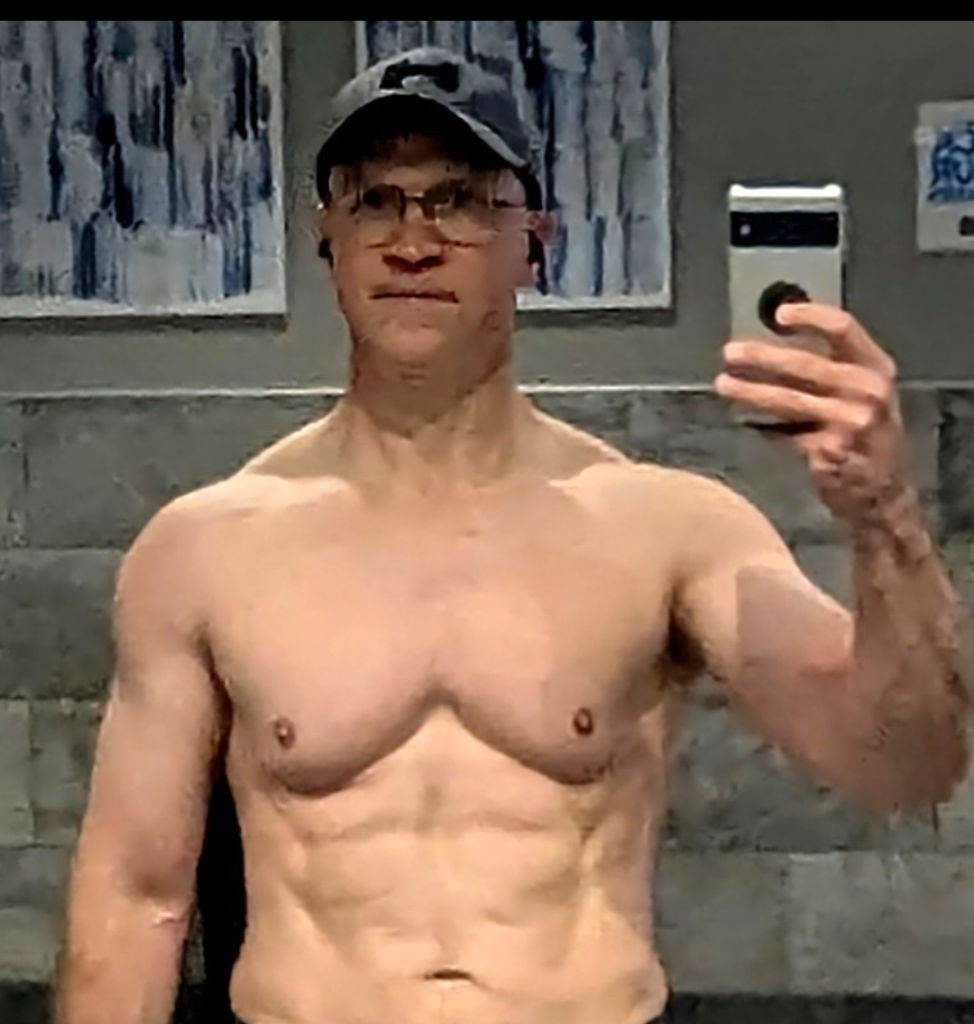
So here I am, a couple years down the road, and I don’t know exactly how long ago it was, but I got where I wanted to go. 180 lean pounds, muscle added, strong looking shoulders and chest, narrow waist, and feeling good. Everything from this point on will be incremental, and I’m totally good with that.
Your Journey to Get Ripped After 40
Here’s my summary about what really matters for you to get ripped after 40. Be patient. I don’t know what your starting point is, but if you are like me, and had neglected this aspect of your life for a while, then relax and give it time. All you can do is the best you can do, and the time to start is right now.
Whether it takes a month or 5 years doesn’t matter. You need to do it. For yourself, and for your loved ones. My wife always reminded me that it was years of accumulated neglect, over-eating, and sedentary lifestyle that got me to that point, so it was unrealistic to think I could undo it all in a few months.
Resistance is real. Anytime you set out to do something amazing, you can expect resistance. Your body will adapt, and you will have to adapt to that. You may get some injuries. I certainly have had moments with achy joints, sore tendons, total exhaustion, and other minor maladies. You’re human. Don’t push through! Give yourself the time you need to recover. Rest. Feed yourself if you need to occasionally. Make sure you sleep enough (more than 7 hours, please).
Stay committed. Here’s an interesting observation you may have seen in your own experience. People who are disciplined with their bodies, are typically disciplined with other aspects of their lives. I’m not sure which is the chicken and which is the egg, but if they work out regularly, eat right, make good decisions, then they probably save money, invest, have more energy for working, bring their best selves to other obligations, show up for their families more, and on and on. There’s a direct correlation between the mental fitness required to stay physically disciplined and being disciplined in finances, relationships, work, and more.
I hope this post about my fitness journey has been helpful. There’s more to it that I can share, but this post got a little longer than I intended. If you want to ask me anything, or get any suggestions or feedback on your current health journey, I’m here for you. Contact me or comment below. I’ll do whatever I can to help you reach your goals.
Great stuff. I’m 53 and have been working out off and on since college but I for sure learned quite a bit from you sharing your journey. Thanks!